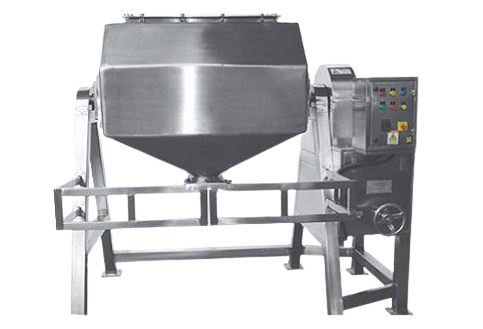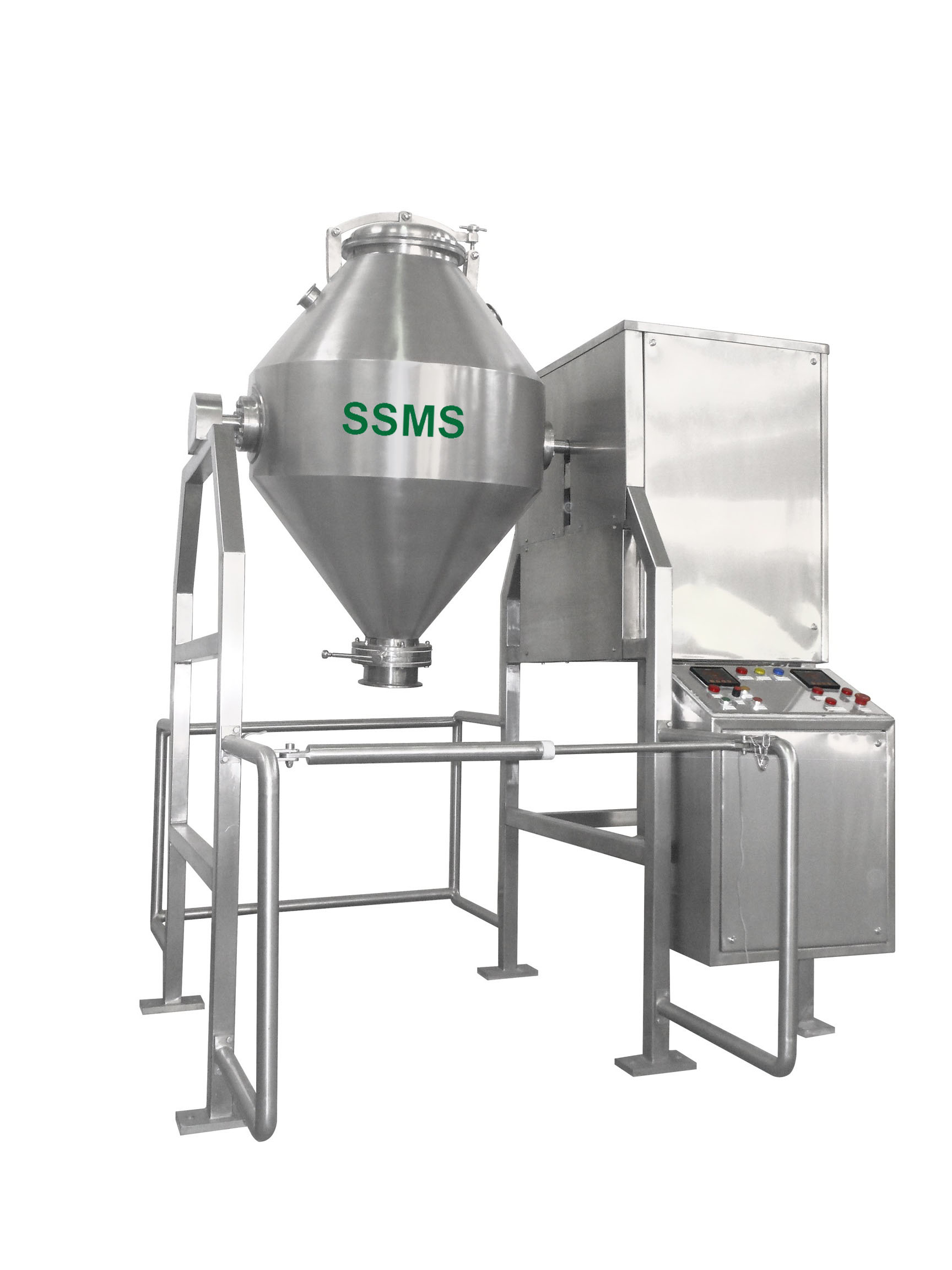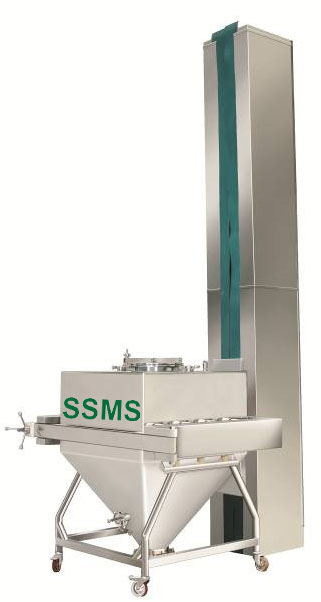
All three are diffusion (tumble) blenders: a closed shell rotates end over end, and the powder bed repeatedly lifts and cascades so particles spread through the batch. None of them has an internal agitator, so shear is low and granules survive intact. The choice between them is about shell geometry and material handling — working volume for a given room height, how the batch gets in and out, how fast you can clean between products, and how cleanly the design scales up.
The three geometries
| Double Cone | Octagonal | Bin / IBC Blender | |
|---|---|---|---|
| Shell shape | Two cones on a cylindrical band | Octagonal barrel with baffled ends | Square-section bin clamped into a rotating yoke |
| Working volume vs footprint | Moderate | High — more volume in less height | High; volume set by the bin |
| Loading | Charge port at top | Charge port at top | Fill the bin at a separate station |
| Discharge | Butterfly valve at the lower cone | Butterfly valve at the discharge cone | Bin's own valve; bin leaves with the blend |
| Cleaning | CIP or manual, one fixed shell | CIP or manual, one fixed shell | Bins washed off-line; blender body stays clean |
| Best fit | Small–medium batches, simple line | Larger batches where headroom is tight | Multi-product suites, containment, bin-to-press flow |
The SSMS Engineers Double Cone, Octagonal and Bin Blender share the same running gear: a heavy-duty SS 304 square-tube frame, a variable frequency drive for speed control, a self-positioning sensor that stops the shell with the discharge pointing down, and a manually operated butterfly valve with a Tri-Clamp adaptor that doubles as a safeguard against product loss. All are offered from 2.5 kg lab bins up to 5000 kg.
When each one fits
Double Cone Blender — the default for lab, pilot and modest production batches. The symmetrical cones give a clean tumbling pattern with no dead zones, and there is only one shell to qualify and clean. Choose it when the line makes one or a few products, batch sizes are moderate, and there is enough ceiling height for the cone to swing.
Octagonal Blender — the same low-shear tumbling in a shell that packs more working volume into less vertical space. The flat octagonal faces and end baffles keep the bed turning over at larger scale. Choose it when batch size is large, when head height is limited, or when you want the biggest blend the room will take without going to bins.
Bin / IBC Blender — the blend is made inside a portable intermediate bulk container that clamps into the rotating yoke. Choose it when you run many products and changeover time dominates: the bins are washed off-line while the blender keeps working, cross-contamination risk drops, and the same bin carries the blend straight to the tablet press or capsule filler with no intermediate transfer. It also suits potent compounds, because charging and discharge can be closed.
Getting a good blend, whichever shell you pick
- Fill level. Load to roughly 50–60% of the shell's gross volume. Tumble blenders need headspace for the bed to cascade; overfilling collapses the mixing action.
- Speed. Production tumble blenders typically run in the region of 8–20 rpm. Too slow and the bed slumps instead of cascading; too fast and centrifuging pins the powder to the wall. The VFD lets you dial this in for the formulation.
- Time. Blend uniformity rises quickly, plateaus, and — for lubricated blends — can then fall as the magnesium stearate over-coats the particles and hurts tablet hardness and dissolution. Fix blend time and the lubricant addition point in the batch record; do not "blend a bit longer to be safe".
- Segregation. A perfect blend can still separate on the way to the press if the particle size or density spread is wide. Keep transfer drops short, and consider moving lubrication or final blending closer to the press (a bin blender helps here).
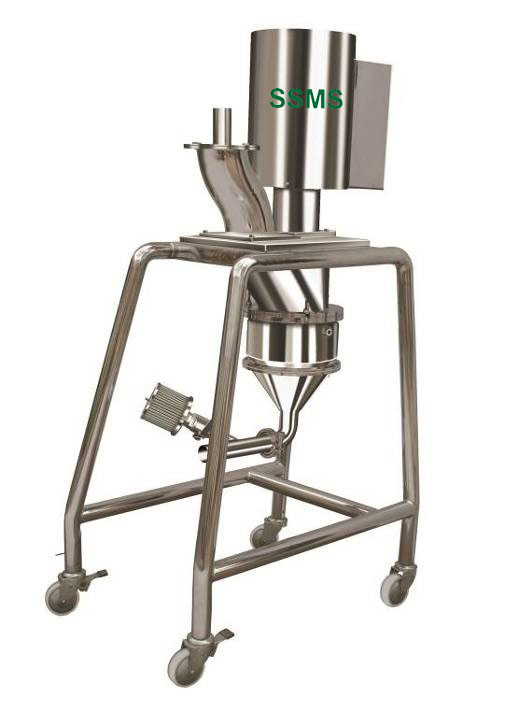
- Sieve or mill first. Lumps do not break up in a tumble blender. De-lump the actives and excipients through a Co Mill or sifter before charging — a Co Mill can even be mounted in-line while the bin is filled.
Scaling up
Tumble blending scales reasonably well if you hold the Froude number (a function of shell speed and radius) roughly constant, so the bed behaves the same at 50 L and 2000 L. Keep the fill fraction the same too, and expect blend time to grow modestly, not linearly. Validate the scaled process with stratified blend-uniformity sampling — top, middle and bottom of the shell, plus the discharge.
Talk it through with us
Tell us the batch-size range, the number of products on the line, your ceiling height, and whether containment or bin-to-press flow matters, and we will recommend the shell and size it. Contact SSMS Engineers, or compare the Octagonal Blender, Double Cone Blender and Bin Blender specifications.